


MiYOSMART iQ by HOYA: advanced myopia control from age 4
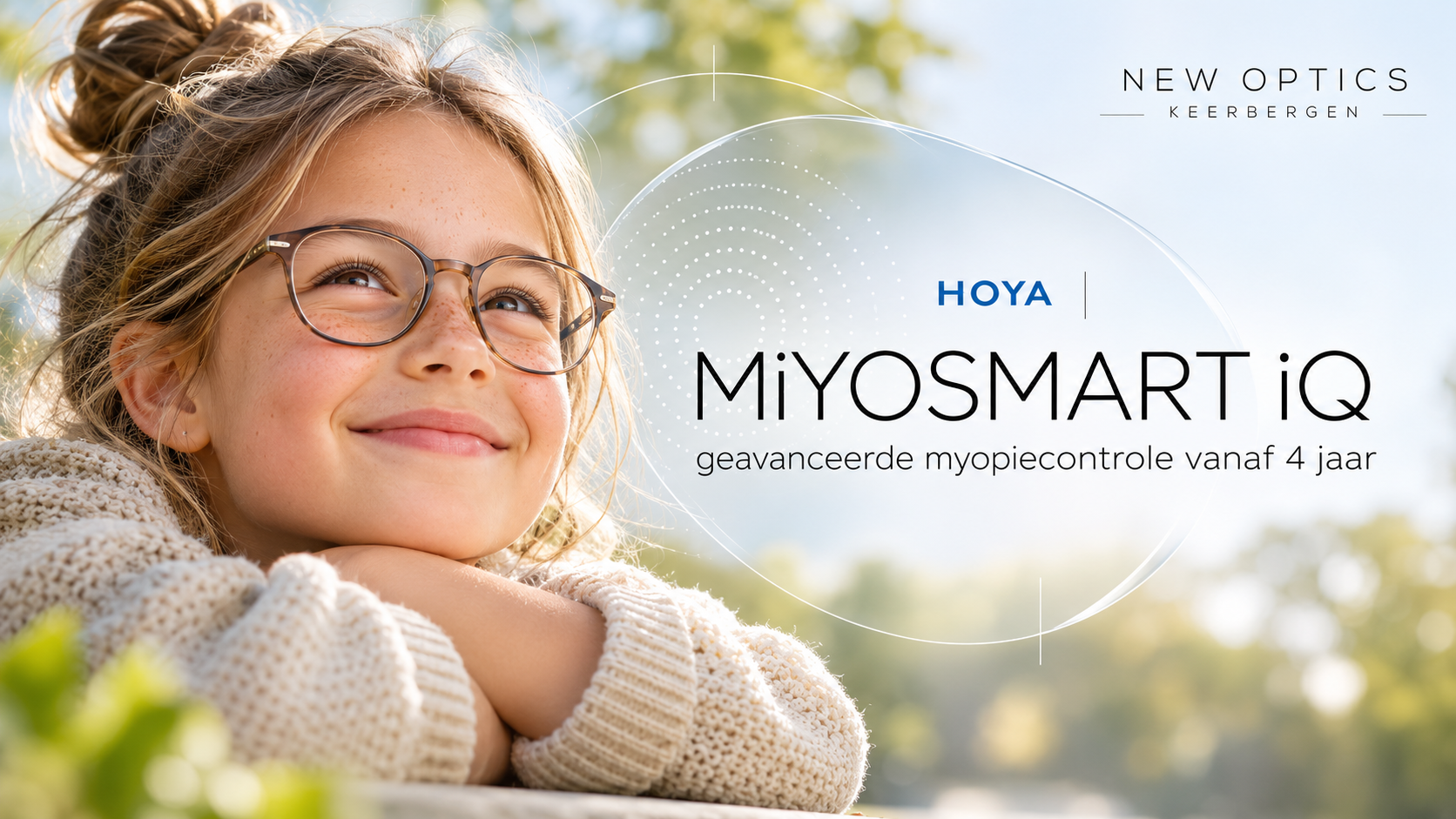
Is your child becoming increasingly nearsighted? Regular glasses help your child see clearly again, but do not slow down the progression of nearsightedness. With MiYOSMART iQ, HOYA introduces a new generation of myopia-control spectacle lenses for children aged 4 and up. The lenses combine clear vision with a special optical design that can slow down the progression of myopia.
What is myopia and why is early intervention important?
Myopia, or nearsightedness, means that a child can see well up close, but sees distant objects as blurry. This is often because the eye grows too long. During childhood, the prescription can increase rapidly. Higher levels of myopia are associated with a greater risk of certain eye problems later in life, including retinal detachment and myopic macular problems.
Therefore, myopia control goes beyond simply seeing clearly: the goal is also to slow the progression of nearsightedness as much as possible.
What makes MiYOSMART iQ different from ordinary children’s glasses?
MiYOSMART iQ builds on HOYA’s existing D.I.M.S. technology (Defocus Incorporated Multiple Segments). The spectacle lens contains a zone that provides clear vision and a treatment zone that emits a myopic defocus signal. This signal is intended to slow down excessive eye elongation.
Three refinements with Triple Enhanced Design
HOYA calls the renewed design Triple Enhanced Design (DIMS TED). It includes three improvements:
- More targeted activation: the defocus segments are located closer to the center of the lens to stimulate the near-peripheral retina.
- A stronger signal: the optical design enhances myopic defocus.
- An expanded treatment zone: the signal is available across a larger area of the eyeglass lens.
MiYOSMART iQ is therefore HOYA’s most advanced myopia control lens, but not necessarily the best lens for every child. The choice depends on the eye measurements, the progression of myopia and the ophthalmologist’s advice.
What do the clinical results show in children?
In a randomized, controlled study reported by HOYA involving children aged 4 to 12 years, 9 out of 10 children with MiYOSMART iQ showed no clinically relevant myopia progression in the first twelve months. In that study, clinically relevant means an increase of at least 0.50 diopters. On average, eye length growth remained limited in the treated group.
These figures are promising, but they do not mean that myopia comes to a complete stop in every child. The results cover the first twelve months and may vary depending on age and individual starting situation. Long-term follow-up therefore remains important. Read HOYA’s explanation and research references.
The glasses are designed for children with increasing nearsightedness, also from 4 years. That is not the same as saying that every nearsighted child automatically needs MiYOSMART iQ from that age. In particular, the rate at which the minus prescription changes, eye length, family history and previous treatments are important factors in the assessment.
For children under the age of 16, the prescription and medical assessment are handled by the ophthalmologist. At New Optics, parents can then receive expert advice on the lenses, the choice of frame and precise lens centering.
Children’s glasses must also be comfortable.
An effective spectacle lens only makes sense if the child wears the glasses consistently. A well-fitting frame and correct positioning of the lenses are therefore essential. HOYA offers MiYOSMART iQ in a clear version (Clear) and a photochromic version (Chameleon) for changing light conditions. The accompanying S.P.A.R.K. coating is designed to make the lenses more resistant to everyday use.
How does the follow-up of myopia control work?
Myopia control is not a one-time purchase. Regular check-ups help determine whether the chosen approach is sufficiently effective. HOYA recommends a follow-up appointment within approximately six months, during which the glasses prescription and, where possible, the axial length of the eye are assessed. The ophthalmologist determines the next steps together with the eye care professionals involved.
In addition, healthy habits remain valuable: spending sufficient time outdoors, taking regular breaks during prolonged close-up work, and ensuring a comfortable viewing distance.
Frequently asked questions about MiYOSMART iQ
Can MiYOSMART iQ cure nearsightedness?
No. The glasses correct vision and are intended to slow the progression of myopia. Existing nearsightedness does not disappear as a result.
Can four-year-old children wear MiYOSMART iQ?
Yes, the glasses have also been clinically tested in children aged four and older. Whether they are suitable for a particular child must be assessed individually.
Is MiYOSMART iQ the same as MiYOSMART?
No. MiYOSMART iQ builds on the original D.I.M.S. technology, but adds the Triple Enhanced Design. Both are intended for myopia control; the appropriate type is determined for each child.
Personal advice at New Optics in Keerbergen
Parents who are concerned about increasing myopia in their child can receive advice at New Optics in Keerbergen about the options for myopia-control spectacle lenses. New Optics helps with choosing the frame and ensuring the precise centering of the lenses, in collaboration with the ophthalmologist.
Want to know more? Contact New Optics to discuss the options for your child.
Give your child the right approach to nearsightedness
New Optics in Keerbergen advises parents on myopia-control spectacle lenses and a well-fitting frame, in collaboration with the ophthalmologist.